Why Ullanor matters
Ullanor was the center of a vast Ork empire defeated during the Great Crusade. The campaign culminated in the Triumph of Ullanor, one of the Imperium's defining victories before the Horus Heresy and a moment deliberately framed as the conquest of an existential xenos power.
That fame makes Ullanor easy to mistake for a separate surviving landmark on every later map. Its history, however, continues through the War of the Beast and an extraordinary relocation that complicates the planet's identity.
The War of the Beast and the relocated world
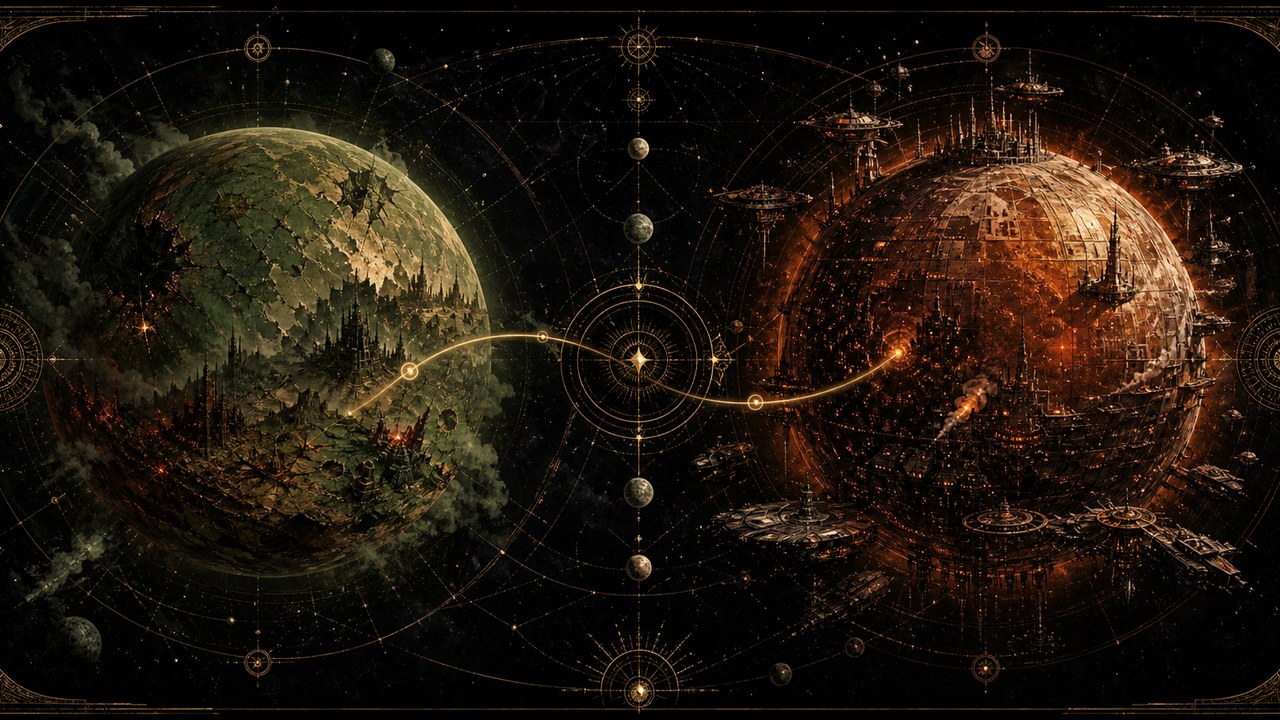
During the War of the Beast, Ullanor again became central to an Ork threat against the Imperium. After the fighting, Adeptus Mechanicus actions moved the world through space rather than leaving its strategic and technological secrets where rival Imperial authorities could easily claim them.
The relocated planet was later known as Armageddon. This is why references to Ullanor and Armageddon can describe different eras and identities of the same underlying world rather than two ordinary neighboring planets.
How the interactive map represents both names
Cartographia Imperialis keeps an Ullanor dossier because readers search for the Great Crusade and War of the Beast under that historical name. It also keeps Armageddon as the later, better-known war world associated with the First, Second, and Third Wars for Armageddon.
The two records are cross-linked so the timeline remains understandable. Opening either dossier provides a path to the other, while the map view emphasizes that the chart is explaining a change in identity and location rather than asserting two simultaneous canonical Ullanors.
Why the map remains approximate
Moving an entire world through mechanisms associated with the War of the Beast is not something an ordinary stellar chart can represent as a measured route. The map therefore prioritizes the narrative relationship and labels the placement as approximate.
For most readers the important takeaway is simple: ancient Ullanor eventually becomes the world later called Armageddon. The dossiers preserve the separate names because each belongs to a different and highly recognizable body of Warhammer 40K history.